LND: Zero-Timestamp Gossip DoS
Technical analysis of a zero-timestamp gossip DoS vulnerability in LND.
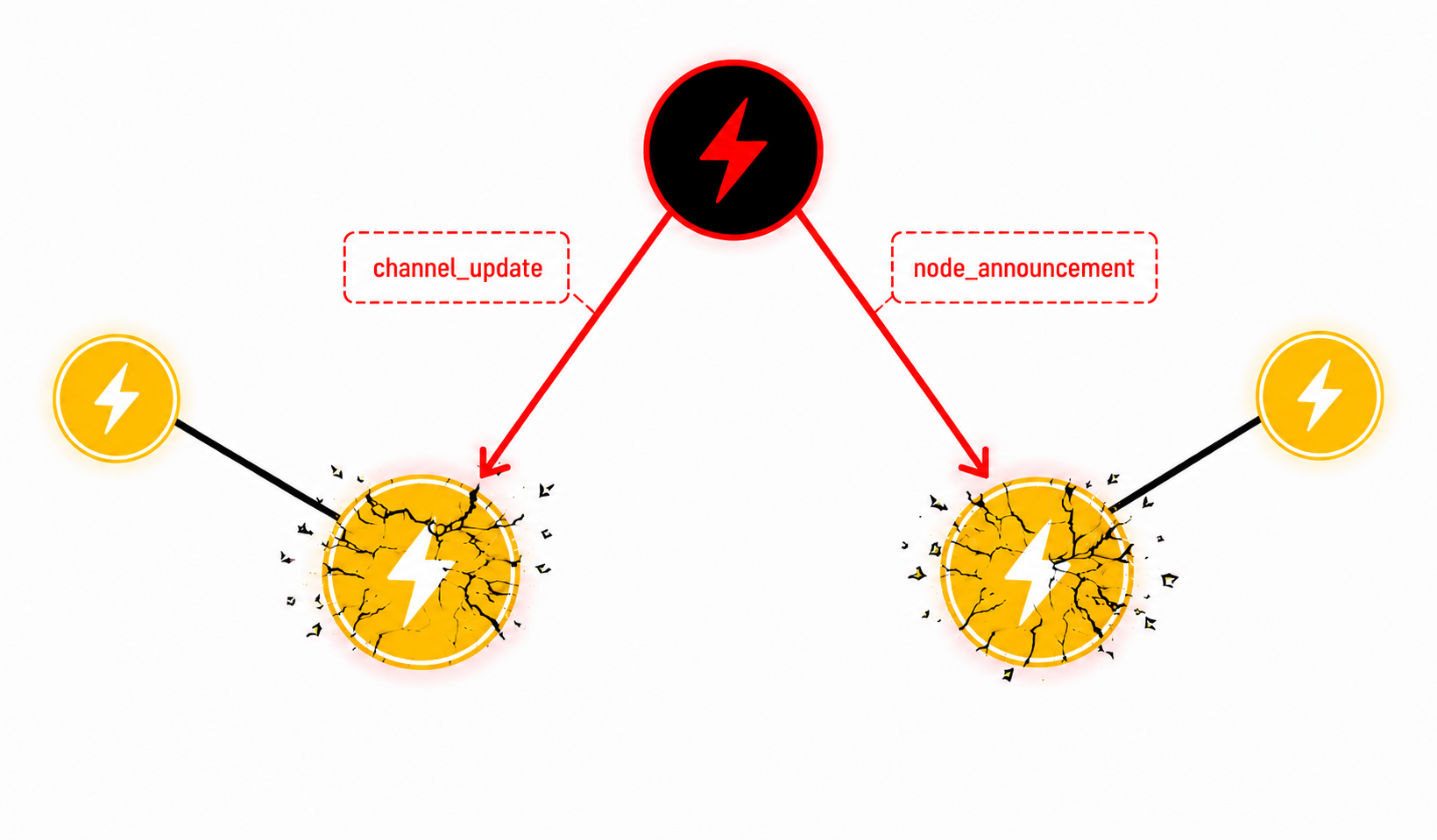
LND versions before v0.20.1 are vulnerable to a DoS issue where a specially crafted channel_update or node_announcement message can crash a node. Operators should upgrade promptly to avoid service disruption. The issue is fixed in v0.20.1 and later.
Vulnerability
The Lightning Network uses gossip messages to maintain a distributed view of the network graph. Nodes exchange channel_announcement, node_announcement, and channel_update messages to advertise channels and routing policies. Before accepting node_announcement and channel_update messages, a Lightning node must first know and validate the corresponding channel_announcement.
After validation, node_announcement and channel_update messages are propagated throughout the network. In LND, this propagation is handled by a gossip rebroadcast pipeline that uses a de-duplication cache to avoid repeatedly forwarding identical announcements. When a new announcement arrives, its timestamp is compared against any previously stored announcements for the same channel, direction and node. Newer announcements replace older ones, while older announcements are discarded. The implementation of this logic prior to v0.20.1 can be found in deDupedAnnouncements.addMsg.
The bug stems from how announcements with a timestamp of 0 are handled. When a zero-timestamp node_announcement or channel_update is received for the first time, no cache entry exists and oldTimestamp remains initialized to 0. As a result, the code incorrectly treats the announcement as a previously seen message and enters the duplicate-message path.
However, because no previous entry existed, the senders map was never initialized. Attempting to write to this nil map triggers a runtime panic that terminates the LND daemon, resulting in a complete loss of node availability until it is restarted.
DoS Attack
As discussed in the previous section, the panic is triggered only after a node_announcement or channel_update has passed validation and entered LND’s gossip rebroadcast pipeline. Because gossip messages are authenticated, an attacker cannot simply modify an existing message; doing so would invalidate its signature and cause it to be rejected before reaching the vulnerable code path.
To exploit the bug, the attacker must generate a validly signed node_announcement or channel_update with a timestamp of 0.
Method 1: Advertise a Real Channel
The simplest approach is to open a public Lightning channel and advertise it normally. When broadcasting the corresponding node_announcement or channel_update, the attacker sets the timestamp to 0. A vulnerable LND node will accept the announcement and eventually trigger the panic.
Attack Cost
This approach requires opening and eventually closing a public Lightning channel, incurring the associated on-chain fees. Furthermore, once the victim has processed the malicious announcement and restarted, the same announcement may be rejected as stale gossip, requiring a new channel to repeat the attack.
Method 2: Advertise a Synthetic Channel
A more efficient approach avoids opening a Lightning channel altogether. The attacker creates a funding transaction paying to a 2-of-2 P2WSH output controlled entirely by keys they own. After the funding transaction confirms, the attacker has sufficient information to construct a valid channel_announcement for a channel that does not correspond to any running Lightning node.
Once the victim accepts the announcement, the attacker sends a corresponding zero-timestamp node_announcement or channel_update, triggering the panic. Because both channel endpoints are attacker-controlled, multiple valid announcements can be generated using different node identities without incurring channel-closing costs.
Attack Cost
This method requires only a funding transaction and its associated confirmation fees. Additional announcements can be created from newly funded outputs, keeping the cost of repeated exploitation relatively low.
Fix
BOLT 7 specifies that the sender of a channel_update MUST set timestamp to greater than 0, but does not explicitly define how receiving nodes should handle violations of this requirement. Due to this ambiguity, LND implicitly assumed that timestamps would always be valid.
For node_announcement, BOLT 7 does not impose any rule requiring the timestamp to be greater than 0. Nevertheless, a zero timestamp carries no meaningful value, so rejecting such announcements is the safest behavior.
The fix rejects zero-timestamp gossip messages at parse time, so they never reach the gossip rebroadcast pipeline, fully mitigating the DoS condition. It can be found in the associated pull request (lnwire: enforce non-zero timestamp in gossip messages).
Discovery
The vulnerability was discovered while developing a gossip-discovery state-machine fuzz target for LND, designed to exercise the gossip subsystem with both valid and malformed messages to ensure that the implementation handled them safely.
Given that Lightning gossip messages are widely propagated and inexpensive to generate, the subsystem represents a high-value attack surface. During fuzzing, a specific message sequence triggered a panic in LND’s discovery subsystem, leading to the identification of a zero-timestamp channel_update vulnerability.
After I disclosed the zero-timestamp channel_update vulnerability, the LND team realized that the same panic could also be triggered via a zero-timestamp node_announcement, and fixed both cases together.
The fuzz target used for discovery is available in the associated pull request.
Timeline
- 2025-12-15: Vulnerability discovered during fuzzing of the gossip-discovery state machine.
- 2025-12-17: Independently confirmed by Matt using an attack program.
- 2025-12-18: Privately disclosed to the LND security mailing list.
- 2026-01-12: Fix merged into LND.
- 2026-02-12: LND v0.20.1 released with the fix.
- 2026-06-16: Gijs confirms that the vulnerability can be disclosed publicly.
- 2026-06-18: Public disclosure of the vulnerability.
Remarks
- This issue highlights the value of state-machine fuzzing in Lightning implementations, as protocol transition bugs are often missed by fuzzers focused only on message parsing.
- The lack of an explicit requirement for handling invalid protocol message fields in the BOLT specification can lead to inconsistent implementations. Explicitly defining rejection behavior, or enforcing defensive validation in implementations, would help prevent similar issues.